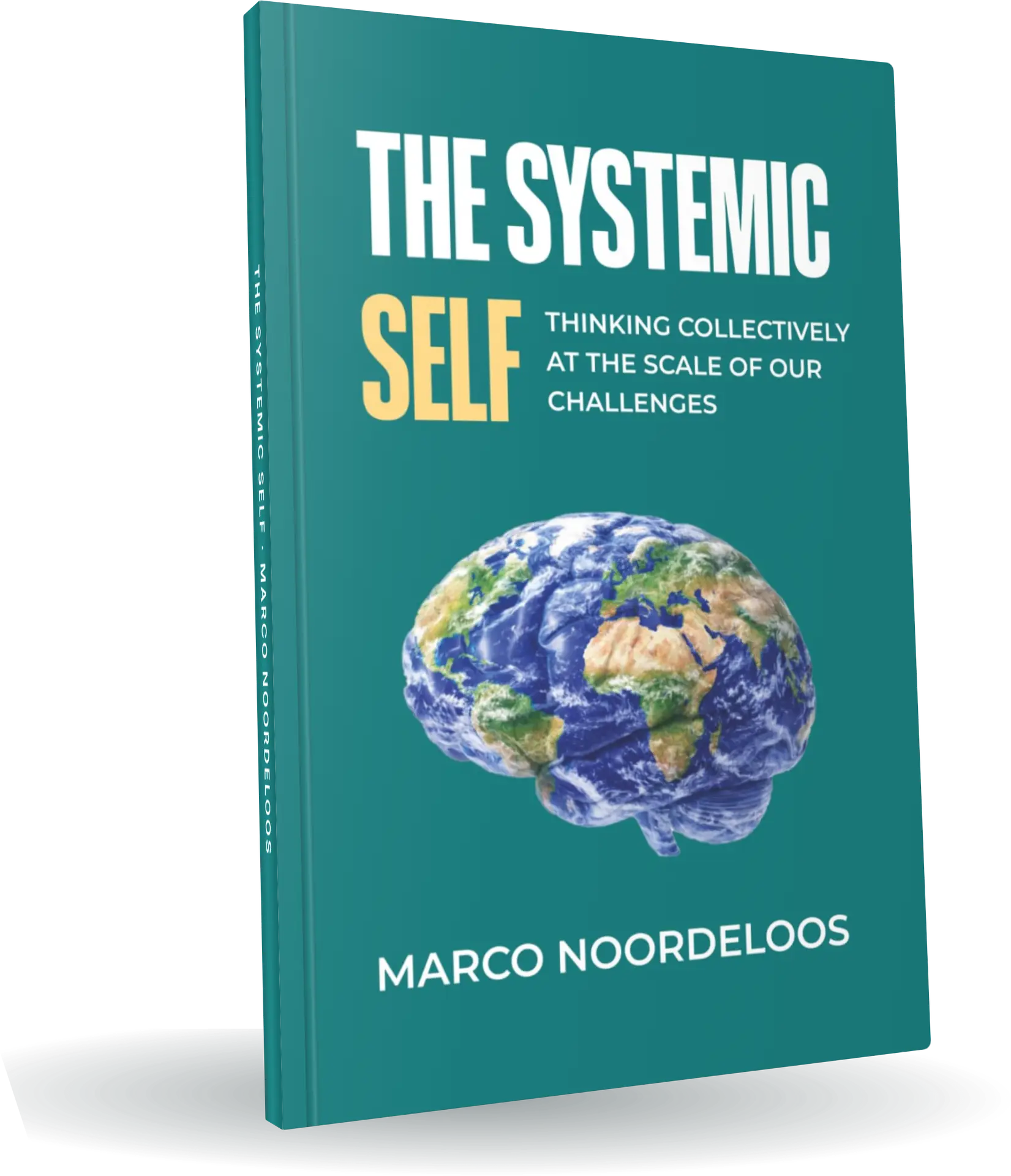
Executive Summary
The Systemic Self argues that the most consequential thing in any institution, the architecture of how its people meet and decide, is almost never designed. Boards, management teams, committees and consortia run on inherited settings, laid down by cultural codes centuries old and a hundred years of management habit, that decide how far ahead a room looks, whose reading of a problem counts, what gets resolved too early, what could change the frame, and who can stop a decision. Nobody in the room chose these settings, and few can see them, which is why capable people keep producing outcomes none of them would defend.
The failure, the book argues, is in the design, and the design suppresses capacities the people already have. Drawing on Robert Kegan's work on adult development and Lene Rachel Andersen's account of cultural codes, it proposes that the capacity institutions now need, to hold more than one way of knowing at once and decide for a horizon longer than the next report, is more often suppressed than absent. Climate does not fit inside the logic of any single institution, and neither does the arrival of machines that think faster than we do; the rooms built for a smaller world cannot register what they leave out.

The failure is architectural.
Most leadership teams are very good at one kind of thinking: short-term and measurable, with one name against each result. That is a design, and nobody designed it on purpose. It persists because the settings have never been visible enough to change.
The settings have names.
Five dials describe how a room is set: Horizon, Perspective, Integration, Feedback and Standing. Each comes with a question, a minimum move, and a test that tells you whether the room changed its architecture or only its conversation.
Wide is not always right.
The dials are context-dependent. A board monitoring a clinical trial is right to hold Standing narrow; widening it would look inclusive and be dangerous. The book objects to settings held by habit, and asks that each one become a choice.
The capacity is already in the room.
A room built on purpose, which the book calls a container, works on the architecture and leaves the people as they are. It lets through what the default filters out: the long view, the knowledge that does not survive a quarterly review, the people who live with the consequences, and the dissent that would otherwise have been managed.
More than one way of knowing.
The modern professional default is one way of making sense among several, and it filters the others out. A room that can hold more than one at once, and decide for a horizon longer than the next report, is what the book means by the Systemic Self.
A compass, and a wager.
The book proposes a direction. The diagnosis, the author believes, holds across the sectors he has worked in; the proof is not in these pages. It will be built and tested in the field over the next few years, with WICE, and published in a second book.
Thirteen Chapters
01.
The Optimisation Trap
Twelve senior experts are asked to lower a light stick to the floor together, and it rises. Nobody is cheating; each is optimising their own finger. The exercise gives the book its first image of drift without bad faith, scaled up to institutions and then to the planet.
02.
The Beautiful Prison
David, a seasoned Director of Programmes, describes a Tuesday of defensible decisions that add up to nothing he believes in. Doing the job well is not enough, because the architecture filters what can be said, and the instinct to fix turns every adaptive problem into a technical one.
03.
Behind the Dashboard
Alistair's model is brilliant and cannot see the Kenya director's evidence. The Five Dials arrive here as a way to read any room: Horizon, Perspective, Integration, Feedback and Standing, how each is set, who benefits from the setting, and why nobody remembers choosing it.
04.
The Codes We Inherited
Elena's community meeting in Kenya collides four ways of making sense: Indigenous, Premodern, Modern and Postmodern. Each solved the coordination problem it evolved for. The Modern code turns out to be the one Western institutions run on without seeing it.
05.
Century of Management
Paula's twenty-eight indicators did not fall from the sky. A hundred years of management paradigms, from scientific management to the resilienceera, hardwired the settings into the institution she runs. Knowing this, the chapter admits, does not by itself change a thing.
06.
The Inner Architecture
Kegan's orders of adult meaning-making, and why professional institutions cultivate the self-authoring stage as a ceiling. The adaptive blind spot gets its name here, along with the cost to people like Peter, who translate between frames that do not fit.
07.
The Manifestations
The five patterns locked dials produce: future myopia, metric capture, the standing gap, feedback immunity and paradox collapse. Alistair's consortium resolves a 2-year tension in an afternoon and feels the relief of a decision made; 6 weeks later the tension is back.
08.
Look in the Wrong Place
Decades of leadership development have treated the gap as a deficit in individuals. The book proposes that the capacity is present and suppressed, and that it appears in a room designed to hold what one person cannot. Peter was carrying what the architecture should have carried.
09.
Grammar of Containers
What a room built on purpose is made of: boundary, aim, rules of contact, rhythm, and memory. Elena's Climate Working Group show the grammar in use, the decision-rights matrix makes Standing concrete, and the Container Guardian is a function the room needs filled.
10.
Biology of Holding
Peter notices his hands. Under sustained threat the nervous system narrows, complexity collapses, and the dials lock in the body before they lock in the room. A container therefore has to be safe enough to think in, and the chapter says plainly where the evidence ends.
11.
Power & Legitimacy
The strongest case for the Modern code, made in full, and then the question it leaves open, which is who loses power when a dial turns. Elena's experiment in moving authority from Geneva toward the village shows what a sponsor pays.
12.
The Shadow Side
Containers can go wrong, by mimicry, by the costume that uses the book's vocabulary without its substance, and by the slow drift toward totalism. Six safeguards follow, from dissent rights to whistleblower protection, with the warning signs for each.
13.
What Comes Next
Peter gets a different Tuesday. The container as institutionalised Polymodernity, the book's position among adjacent movements, and a glimpse twenty-five years ahead. And an invitation to the work that becomes the second book.
